
Our service engineers are exposed to many different working environments and visit sites up and down the country on a daily basis. This exposure provides an additional level of insight that is very useful for many reasons and one that we are privileged to be afforded with. It is therefore important that we learn from these experience, not only as a business but as individuals.
Training in service never stops, most days engineers will face something new and understanding of processes and outcomes is continually developing.
Feedback is really important – experiences / observations bring what can be theoretical occurrences to reality.
Much of the UK’s industrial installations are ageing – and as plants age, new issues can arise. It is not uncommon when attending a site for a CEMs service engineer to have been the last person to have visited the CEMs location. This is where not only ‘Establishing General Safety’ but also ‘Leaving the Site in a Safe Position’ is very important.
Whilst inspection of stack platforms and chimneys are the responsibility of other parties to inspect, the vigilance of an additional pair of eyes is important – leaks from ducting not only cause potential localised release of (noxious) fugitive emissions, they also lead to accelerated corrosion of plant – which can have catastrophic outcomes.
Recent observations have included:
Badly blanked redundant port
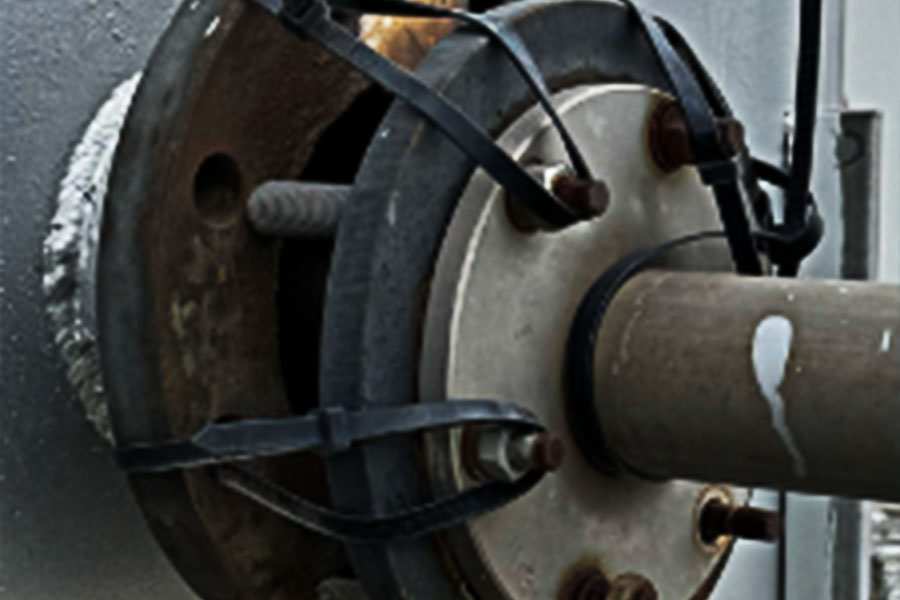
A ‘spare’ port on the stack had been blocked with an ill-fitting flange. This is perhaps not an isolated incident – however, when the blanking plate is secured to the stack with cable ties, and it also has an O2 probe attached to it, it is certainly not ideal. What may have seemed like a quick fix is far from satisfactory and needs (and was) flagged up as so.
Cracked mounting flange
A more subtle issue was a cracked mounting flange. This was only visible on close inspection, but left un-checked / un-actioned could progress to a point where at best, readings are compromised or worse, personnel are exposed to combustion gas which can lead to an even more significant issue.
Instrument attachment issues
Earlier this year a redundant instrument was observed to no longer be securely attached to ductwork. The position was reported immediately and resolution expedited by the client. This was on a remote part of plant so with the infrequent footfall and subsequent lack of visibility, it could have become detached completely.
On another site, we have observed an instrument flange ‘secured’ to a stack with a ratchet strap!
So – what is the take home here?
Observation! Look around, not just at the things you are working on but what they are attached to. If something doesn’t look quite right report it – the next person in that location may well be the next service engineer, by which time the further deterioration may have occurred, putting others in front of an avoidable risk. We are familiar with establishing general safety on many larger installations – this approach / mindset needs to be ever present and requires some vigilance from engineers to ensure it is not a tick box exercise and actually the procedure is used both to ensure the safe working environment but also to improve installations / infrastructure where appropriate.