
There are currently around 60 EfW plants in the UK. This is predicted to grow to around 75 by 2028, treating 21Mt of waste, generating approximately 10Mt of fossil based CO2 emissions.
Historically, Energy from Waste to some was seen as a dirty business, but times are changing and EfW could become a flagship success story in the drive to a low carbon future!
Waste is a global problem which looks set to increase in size. In the UK, waste that would otherwise be going to landfill is being handled in sophisticated EfW plants which both involve treatment before combustion (pre-seperation) and post combustion with a variety of abatement methods to ensure very low concentrations of combustion components are released to the atmosphere. CO2 however does remain as a challenge,1 ton of municipal waste can generate 1 ton of CO2 released into the atmosphere.
With new technologies, EfW plants will be able to dramatically reduce the CO2 emissions from their process and become a low carbon solution and efficient way of solving our waste crisis. I recently heard a lot of talk about negative emissions but perhaps we need to walk before we can run.
Now with the inclusion of EfW and Incineration plants into the ETS (Emissions Trading Scheme) looming, it has introduced a lot of unknowns into the future of EfW.
One thing for sure is that by 2050, we must reach NET ZERO, and we are going to see a lot of change in the EfW sector.
Existing plants will need to closely monitor and account for their CO2 emissions to air. There is likely to be a tax driven incentive to reduce CO2 emissions significantly. Specifically this will be targeted at the emissions derived from anthropogenic activities / materials (Man made). Traceability of the source of CO2 is likely to scrutinised much more closely as the financial consequences of such emissions become significant.
Furthermore , the inclusion of CCS (Carbon Capture and Storage) may need to be considered and implemented; a process that will remove / recover the CO2 by use of an absorber process from the emissions before they are released to air, compressed, and safely stored deep underground in depleted oil or gas reservoirs.
Then there is CCUS (Carbon Capture Usage and Storage); the same removal/recovery process as CCS but the CO2 is captured with the view to is being re-used and therefore moved across the country by pipeline or large vessels by rail, road and even waterways!
The big question is who will bear the cost of this?
- The operator of the EfW plant through the cost of carbon credits?
- The local authorities – by EfW operators increasing the gate fees
(bin lorries entering an EfW facility)? - The consumer through additional charges by the local authority for bin collections?
- The producer – would a higher tax on the use of single use plastics drive producers to
use recycled or carbon neutral packaging?
The other factor to consider is if the costs of EfW gate fees eventually overtake the cost of landfill but with discussions on landfill being banned, are we likely to see further export of our waste to neighbouring countries?
What effect will this have on ageing plants, already struggling to meet the stringent emissions requirements or no space to implement a CCS or CCUS plant.
It’s not clear yet where these costs will sit – discussions with stakeholders are taking place and decisions need to be made quickly! It will be interesting to see how the industry responds over the next 12 months.
For now there are more questions than answers. The EfW sector is certainly strong and there are exciting times ahead for anyone involved.
What is clear is that gas measurements are a vital part of this process. Instrument manufacturers are being challenged to produce the next generation of analysers to meet these demands.
James Gilbert
What is UK ETS for EfW?
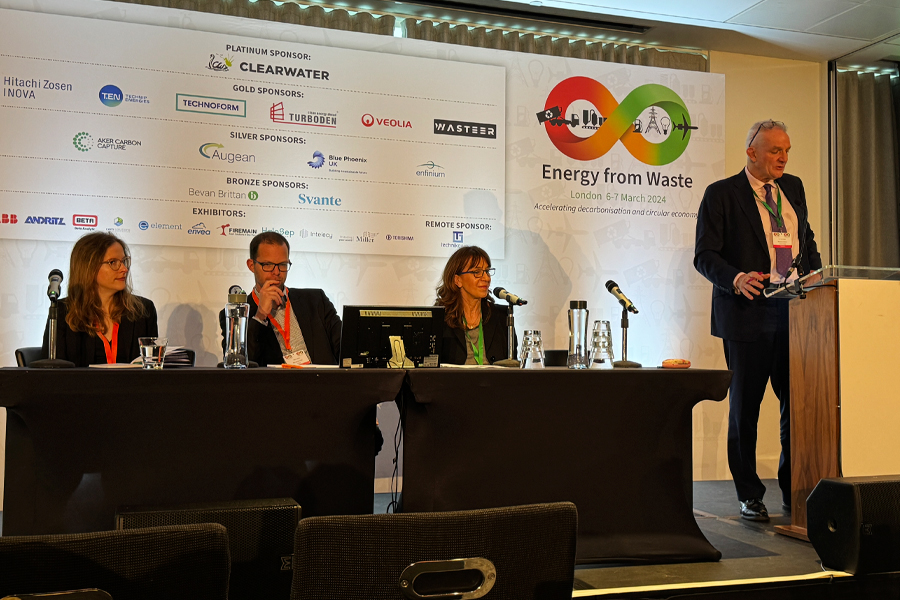
In July 2023 the Government announced that EfW and Incineration plants will be included in the UK’s Emissions Trading Scheme (ETS), so it’s no surprise that this was a very active topic at this years’ EfW conference.
This is the so called ‘cap and trade’ approach to reducing emissions. In simple terms the scheme works like this:
- A limit or cap is set on emissions, which is reduced over time
- The cap is divided into allowances
- Allowances are sold by the Government
- Polluters monitor and report their emissions
- Polluters must buy and surrender enough allowances to cover their emissions
- The supply is reduced over time leading to reduced emissions
The intention is that the ETS will drive down emissions as part of the Government’s aims to meet the target of Net Zero by 2050 by:
- Incentivising investment in low-carbon technologies
- Innovation in low-carbon processes
- Increasing efficiencies
- Change in behaviours
- Use of lower-carbon alternatives
Sam Reed from the UK ETS policy team at the Department for Energy Security and Net Zero (DESNZ) discussed the government’s approach to how this will be implemented. A whitepaper is currently being produced that will provide more clarity on the detail of how this is to be achieved.
Timeframes – there will be a phasing in period from 2026 to 2028 where MRV (Monitoring, Reporting & Verification) only is required, with the scheme applying in full from the 1st of January 2028.
EU ETS
ETS came into effect in Germany on the 1st of January 2024. The carbon price has been fixed for the first few years to provide some stability and certainty. It will be interesting to hear about the experiences and outcomes of other countries as the year progresses.
Challenges
This is a big change for the industry; perhaps the biggest since the introduction of the Landfill Tax in 1996. The main challenges are:
- Cost impacts – where the costs will land and the variability of the carbon price
- Monitoring, measurement and reporting – additional costs & measurement technologies
- Effect on waste exports
Dominic Sheedy